내적과 외적
내적 (Inner Product)
벡터 공간 내의 임의의 두 벡터를 스칼라로 매핑시키는 함수를 내적이라고 한다.
내적의 결과값을 통해 우리는 두 벡터의 방향 유사도나 직교성을 해석할 수 있다.
내적이 정의된 벡터 공간 $(V,\langle\cdot,\cdot\rangle)$를 Inner Product space라고 한다.
Inner Product space에서는 Norm과 Distance가 아래와 같이 정의된다.
\[\lVert\vx\rVert=\sqrt{\langle\vx,\vx\rangle} \tag{2}\] \[d(\vx,\vy):=\lVert\vx-\vy\rVert=\sqrt{\langle\vx-\vy,\vx-\vy\rangle} \tag{3}\]Inner Product의 조건
분배 법칙이 성립
$\langle\mathbf u+\mathbf w,\mathbf v\rangle=\langle\mathbf u,\mathbf v\rangle+\langle\mathbf w,\mathbf v\rangle$
$\langle\lambda\mathbf v,\mathbf w\rangle=\lambda\langle\mathbf v,\mathbf w\rangle$
교환 법칙이 성립
$\langle\mathbf v,\mathbf w\rangle=\langle\mathbf w,\mathbf v\rangle$
자기 자신과의 내적은 항상 0 이상
$\langle\mathbf v,\mathbf v\rangle\geq0$
$\langle\mathbf v,\mathbf v\rangle=0\iff\mathbf v=\mathbf0$
두 벡터가 이루는 각도
Inner Product space에서 두 벡터가 이루는 각도는 아래와 같이 정의된다.
\[\theta=\cos^{-1}\big(\frac{\langle\vx,\vy\rangle}{\lVert\vx\rVert\cdot\lVert\vy\rVert}\big) \tag{4}\]Inner Product의 종류
내적은 다양한 형태로 정의된다.
Dot Product (Scalar Product)
실수 벡터 공간 $\mathbb{R}^n$에서 아래와 같이 정의되는 내적을 Dot Product (또는 Scalar Product)라고 부른다.
\[\langle\vx,\mathbf y\rangle:=\mathbf x^\top \mathbf y \tag{5}\]이는 두 벡터가 서로 얼마나 같은 방향의 성분을 공유하는지, 즉 두 벡터가 얼마나 유사한지를 나타낸다.
값이 클수록 두 벡터가 비슷한 방향을 향하고, 값이 0이면 두 벡터는 서로 직교한다.
일반적으로 $\mathbb{R}^n$에서 Dot Product를 내적이라고 부르는 경우가 많지만, 엄밀히 말하면 Dot Product는 내적의 한 종류이다.
함수의 내적
내적은 벡터뿐만 아니라 함수 공간에서도 정의할 수 있다.
예를 들어, 구간 $[a,b]$에서 정의된 두 함수 $f, g$에 대해 다음과 같이 내적을 정의할 수 있다.
\[\langle f,g\rangle:=\int_a^b f(x)g(x)\,dx \tag{6}\]이 내적은 두 함수가 구간 $[a,b]$에서 얼마나 비슷한 형태를 가지는지 측정한다.
외적 (Outer Product)
두 벡터의 곱으로 행렬을 생성하는 연산을 외적이라고 한다.
\[\vx\otimes\vy:=\vx\vy^\top \tag{7}\]$\vzero$을 제외했을 때, 외적으로 생성된 행렬의 Rank는 항상 1이다.
벡터곱 (Cross Product)
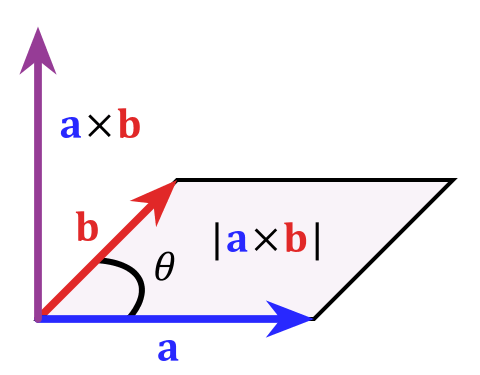
벡터곱은 3차원 벡터에 대해서만 정의되는 연산으로, 두 3차원 벡터에 수직인 벡터를 생성하는 연산이다.
\[\vx\times\vy:=\begin{vmatrix}\vi&\vj&\vk\\x_1&x_2&x_3\\y_1&y_2&y_3\end{vmatrix}=(x_2y_3-x_3y_2)\vi-(x_1y_3-x_3y_1)\vj+(x_1y_2-x_2y_1)\vk \tag{8}\]외적 연산으로 생성된 벡터의 방향은 오른손 법칙으로 결정되고, 크기는 두 벡터가 만드는 평행사변형의 넓이와 같다.