사영 (Projection)
벡터 위로의 사영 (Projection onto a Vector)
기저가 $\vb$인 직선 벡터 공간 $\mathcal{U}$가 있을 때, 벡터 $\vx$의 $\mathcal{U}$ 위로의 정사영 $\text{proj}_\mathcal{U}(\vx)$는 다음과 같이 정의된다.
\[\text{proj}_\mathcal{U}(\vx) =\frac{\vb\cdot\vx}{\vb\cdot\vb}\vb =\frac{\vb^\top\vx}{\lVert\vb\rVert^2_2}\vb \tag{1}\]내적은 $\vb^\top\vx=\lVert\vb\rVert\cdot\lVert\vx\rVert\cos\theta$으로 정의되기 때문에 내적값에는 $\lVert\vb\rVert_2$이 포함되어 있다.
또한 $\vx$의 정사영의 크기는 $\lVert\vx\rVert\cos\theta$이지만, 뒤에 곱해져 있는 $\vb$는 단위 벡터가 아니기 때문에 여기에도 $\lVert\vb\rVert_2$이 포함되어 있다.
따라서, 정사영을 구할 때 L2 Norm의 제곱인 $\lVert\vb\rVert_2^2$를 나눠야 한다.
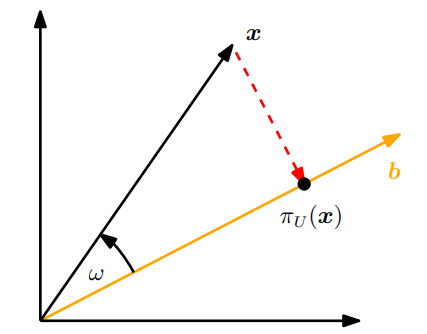 출처: Deisenroth, Faisal, & Ong, Mathematics for Machine Learning
식 (1) 유도
1. $\text{proj}_\mathcal{U}(\vx)$는 $\mathcal{U}$ 내의 벡터이기 때문에 $\vb$의 상수배이다.
\[\text{proj}_\mathcal{U}(\vx)=\lambda\vb\]2. $\vx-\lambda\vb$는 $\vb$와 직교한다.
\[\langle\vx-\lambda\vb,\vb\rangle=0\to \vx^\top\vb=\lambda\vb^\top\vb\]3. 수식을 정리한다.
\[\lambda=\frac{\vb^\top\vx}{\vb^\top\vb}~\to~\text{proj}_\mathcal{U}(\vx)=\frac{\vb^\top\vx}{\lVert\vb\rVert}\vb\]부분공간 위로의 사영 (Projection onto Subspaces)
기저 집합이 $B$인 벡터 부분공간 $\mathcal{U}$가 있을 때, 벡터 $\vx$의 $\mathcal{U}$ 위로의 정사영 $\text{proj}_\mathcal{U}(\vx)$는 다음과 같이 정의된다.
\[\text{proj}_\mathcal{U}(\vx)=B(B^\top B)^{-1}B^\top\vx \tag{2}\]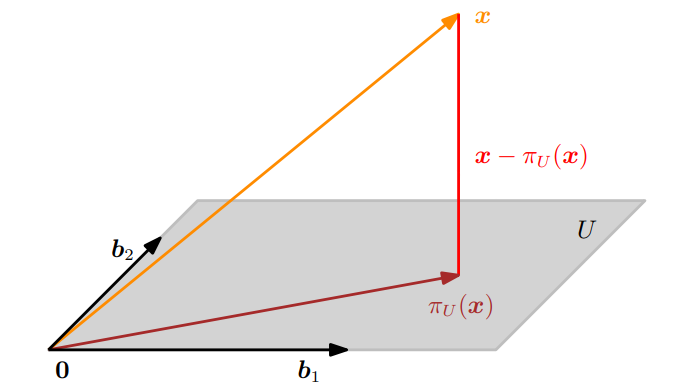 출처: Deisenroth, Faisal, & Ong, Mathematics for Machine Learning
식 (2) 유도
1. $\text{proj}_\mathcal{U}(\vx)$는 $\mathcal{U}$ 내의 벡터이기 때문에 기저들의 선형 결합으로 표현될 수 있다.
\[\text{proj}_\mathcal{U}(\vx)(\vx)=\lambda_1\vb_1+\cdots+\lambda_m\vb_m=B\boldsymbol\lambda\]2. $\vx-\pi_\mathcal{U}(\vx)$는 $U$의 basis들과 직교한다.
\[\langle\vx-\pi_\mathcal{U}(\vx),\vb_1\rangle=0\\\vdots\\\langle\vx-\pi_\mathcal{U}(\vx),\vb_m\rangle=0\]3. 위의 수식을 행렬로 표현한다.
\[\langle\vx-B\boldsymbol\lambda,B\rangle=0 \to\vx^\top B=(B\boldsymbol\lambda)^\top B\]4. 수식을 정리한다.
\[\boldsymbol\lambda=(B^\top B)^{-1}B^\top\vx~\to~\text{proj}_\mathcal{U}(\vx)(\vx)=B(B^\top B)^{-1}B^\top\vx\]$\vx$의 정사영은 $\mathcal{U}$의 기저들의 선형 결합으로 표현될 수 있다. 따라서 선형 결합 계수 $\lambda$만 안다면 $\text{proj}_\mathcal{U}(\vx)$를 바로 구할 수 있다.
\[\text{proj}_\mathcal{U}(\vx)=B\boldsymbol\lambda \tag{3}\]Example: 부분공간으로 정사영된 벡터 구하기
어떤 부분공간 $\mathcal{U}$의 기저 집합이 다음과 같을 때,
\[B=\begin{bmatrix}0&1&-3\\-1&-3&4\\2&1&1\\0&-1&2\\2&2&1\end{bmatrix}\]벡터 $\vx=\begin{bmatrix}-1\\-9\\-1\\4\\1\end{bmatrix}$를 $V$으로 정사영 시킨 결과는 다음과 같이 구할 수 있다.
먼저 $\vx-B\boldsymbol\lambda$와 $B$는 서로 수직이기 때문에, 아래의 식이 성립한다.
\[\langle\vx-B\boldsymbol\lambda,B\rangle=0~\to~B^\top(\vx-B\boldsymbol\lambda)=0~\to~B^\top\vx=B^\top B\boldsymbol\lambda\]즉, 아래의 방정식을 풀어 $\boldsymbol\lambda $를 구하면 $\text{proj}_\mathcal{U}(\vx)$를 구할 수 있다.
\[[B^\top B\mid B^\top\vx]=\begin{bmatrix}\begin{array}{ccc|c}9&9&0&9\\9&16&-14&23\\0&-14&31&-25\end{array}\end{bmatrix}~\to~\boldsymbol\lambda=\begin{bmatrix}-3\\4\\1\end{bmatrix}\]결과적으로, 부분공간 $\mathcal{U}$ 위로의 정사영된 벡터는 다음과 같다.
\[\text{proj}_\mathcal{U}(\vx)=B\boldsymbol\lambda=\begin{bmatrix}1\\-5\\-1\\-2\\3\end{bmatrix}\]