Norm & Distance
Norm
Norm은 벡터의 길이로 정의되며, 벡터를 스칼라로 mapping하는 일종의 함수로 볼 수 있다.
\[\lVert\cdot\rVert:V→\Bbb R \tag{1}\]Lp Norm은 아래와 같이 정의되며, 주로 사용하는 Norm은 L1 Norm과 L2 Norm이다.
\[\lVert\vv\rVert_p:=\left(\sum_{i=1}^{n}{\vert v_i\vert}^p\right)^{\frac{1}{p}} \tag{2}\]L1 Norm (Manhattan Norm)
L1 Norm은 벡터 원소 절댓값의 합으로 정의된다.
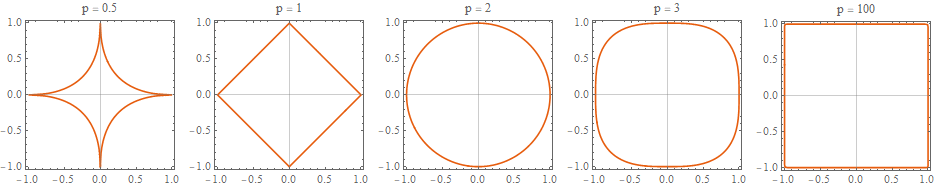
\[\lVert\vv\rVert_1:=\sum_{i=1}^{n}{\vert v_i\vert} =\vert v_1\vert+\cdots+\vert v_n\vert \tag{3}\]2차원 공간에서 단위 벡터 $\vx$의 L1 norm은 $\vert x_1\vert+\vert x_2\vert=1$이며, L1 norm이 1인 벡터들의 궤적은 정사각형 형태로 나타난다.
L2 Norm (Euclidean Norm)
L2 Norm은 벡터 원소 제곱합의 제곱근으로 정의된다.
\[\lVert\vx\rVert_2:=\sqrt{\sum_{i=1}^{n}{v_i^2}} =\sqrt{v_1^2+\cdots+v_n^2} \tag{4}\]2차원 공간에서 단위 벡터 $\vx$의 L2 norm은 $x_1^2+x_2^2=1$이며, L2 norm이 1인 벡터들의 궤적은 원의 형태로 나타난다.
아래 그림은 $p$ 값에 따른 궤적의 변화를 나타낸다.
Norm의 조건
Absolutely homogeneous
$\lVert\lambda\vx\rVert=\lambda\lVert\vx\rVert$
Triangle inequality
$\lVert\vx+\vy\rVert\leq\lVert\vx\rVert+\lVert\vy\rVert$
Positive definite
$\lVert\vx\rVert\geq0$
$\lVert\vx\rVert=0\iff\vx=\vzero$
Distance
Distance는 말 그대로 벡터 공간 $V$에서 두 벡터 $\vx$, $\vy$ 사이의 거리를 의미하며, 벡터 차이의 Norm으로 정의된다.
\[d(\vx,\vy):=\lVert\vx-\vy\rVert \tag{5}\]LpNorm을 사용한 Lp Distance는 위와 같이 정의된다.
\[d_p(\vx, \vy) := \lVert \vx - \vy \rVert_p = \left( \sum_{i=1}^{n} |x_i - y_i|^p \right)^{\frac{1}{p}} \tag{6}\]L1 Distance (Manhattan Distance)
\[d_1(\vx,\vy):=\sum_i^n\lvert x_i-y_i\rvert \tag{7}\]L2 Distance (Euclidean Distance)
\[d_2(\vx,\vy):=\sqrt{\sum_{i=1}^{n}{(x_i-y_i)^2}} \tag{8}\]Distance의 조건
Symmetric
$d(\vx,\vy)=d(\vy,\vx)$
Triangle inequality
$d(\vx,\vz)\leq d(\vx,\vy)+d(\vy,\vz)$
Positive definite
$d(\vx,\vy)\geq0$
$d(\vx,\vy)=0\iff \vx=\vy$